How the Automation Slowdown Reshaped the Smart Conveyance Market in China’s Favor
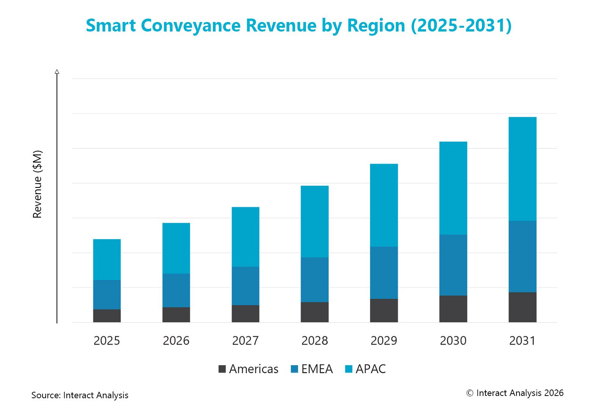
Many industrial automation markets slowed in 2024 and 2025 as geopolitical uncertainty delayed investment. Project delays weakened demand for smart conveyance technology across the Americas and EMEA, while China benefited from continued investment in battery manufacturing and semiconductor production. As a result, China’s share of the global smart conveyance market rose to 46.4%.
This period did more than temporarily alter regional growth rates. It gave Chinese suppliers room to expand while established European and North American providers faced weaker demand in their domestic markets. Although market conditions are improving in 2026, the competitive and regional balance has already shifted.
China’s unique industry mix helped support demand
Despite the broader industrial automation slowdown, battery manufacturing remains a bright spot. The overall smart conveyance market is forecast to grow by 19.5% in 2026, but revenue from battery manufacturing is projected to rise by 32.7%, highlighting the industry’s importance as a driver of demand.

Although battery manufacturing takes place globally, China has the largest footprint. The region represented 25% of smart conveyance revenue generated by the battery manufacturing industry in 2025. This concentration helped China outperform other regions during the downturn.
Battery manufacturing also has an outsized impact on the smart conveyance market. The industry accounted for nearly 30% of global smart conveyance revenue in 2025, making regional exposure to battery manufacturing particularly important. Battery manufacturers have both the capital budgets and the operational requirements needed to justify investment in smart conveyance systems.
Several characteristics of battery manufacturing make it an important market for smart conveyance systems:
- Capacity expansion often involves greenfield facilities, creating opportunities to install new automation technologies.
- Battery production typically requires long tracks and high mover counts, increasing system value.
- Government incentives and industrial policies encourage domestic capacity expansion, supporting investment even during economic downturns.
Putting these points together, China’s growth was supported by its industry mix and the type of manufacturing investment, not simply a faster economic recovery.
Chinese suppliers used domestic demand to expand
Strong domestic demand allowed Chinese suppliers to expand despite weak conditions elsewhere. Zongwei and Golytec are among the vendors growing rapidly. Zongwei, for example, recently announced that it had delivered 50,000 meters of track and completed a Pre-C+ funding round that raised 200 million CNY, equivalent to approximately $30 million USD. While many European and North American vendors experienced slower order activity, Chinese suppliers such as these continued delivering systems and developing new products, gaining an edge.
Chinese suppliers also compete at significantly lower price points. In some cases, their smart conveyance systems cost as little as one-fifth of comparable offerings from global suppliers. This cost advantage becomes even more pronounced in larger installations with longer tracks and higher mover counts. As a result, battery manufacturing represents a particularly attractive market for lower-cost Chinese suppliers.
When could Chinese suppliers expand into EMEA and the Americas?
If current trends continue, Chinese suppliers could begin competing more directly with established vendors in EMEA and the Americas. During the downturn, Chinese suppliers expanded their installed bases and gained valuable experience across applications, system configurations, and customer requirements. This experience will support continued product development, while helping suppliers to identify new use cases and sources of demand.
The motion control market offers a useful comparison. Inovance leveraged its strong position in China to become a leading motion control supplier before expanding aggressively into international markets. Although smart conveyance is a smaller and less mature market, it could follow a similar trajectory.
Over the next five to ten years, Chinese smart conveyance suppliers could begin establishing a more meaningful presence in EMEA and the Americas. Price competition is likely to be the most immediate consequence, particularly in large-scale applications where track length and mover counts make system cost especially important.
How established vendors can respond
The next five years will be critical for vendors looking to defend their positions in the smart conveyance market. As price competition intensifies, established suppliers will need to differentiate through local engineering expertise, responsive technical support, and strong after-sales service. These capabilities remain a significant competitive advantage because building an effective local support network requires substantial investment. With skilled manufacturing and engineering labor in short supply, many customers are willing to pay a premium for faster support and reduced reliance on scarce internal resources.
Smart conveyance also has relatively high switching costs. Track design, controls, and software are often specific to an individual supplier’s platform. Replacing an existing system can therefore require substantial system redesign. Vendors that build a large installed base today may benefit from subsequent system expansions, repeat projects, and long-term customer relationships.
For established vendors, the strongest defense against lower-cost competition will be to secure customers early and clearly demonstrate the long-term value of local support, technical expertise and lifecycle services.
Final thoughts
Improving demand in 2026 will support growth across all major regions, but it is unlikely to restore the market’s previous regional balance. China enters the recovery with a larger installed base, greater exposure to the fastest-growing applications, and a stronger domestic supplier base. Chinese suppliers have also emerged from the downturn with stronger customer relationships and broader installation experience. As a result, established vendors will find it increasingly difficult to regain share in China, particularly in price-sensitive, large-scale applications.