Surging revenues for construction equipment OEMs conceal weakness in North American demand
OEM revenues in the North American construction equipment market are surging, primarily driven by the influx of data center projects, particularly in the US. However, are these surging revenues hiding the true picture: a construction market struggling in almost all major categories except one?
Caterpillar leads the pack

Our recent analysis shows that revenues from the sale of construction equipment are surging in North America. YoY growth has been accelerating for the last 3 quarters, with Caterpillar recording a 50% increase for Q2 2026 versus the same period last year.
The reason for the surge in growth? The phenomenal amount of CAPEX flooding into AI to scale data center compute resources. These vast facilities require huge amounts of earth moving equipment to prepare the sites, provide utility connections, and construct the facilities.
So, this is all good news for the North American construction equipment market, right?
Not all is well in Eden
After a difficult period of lockdowns, a war in Ukraine, and trade wars, OEMs in North America should, rightly, have reason to cheer. Revenues are up.
The reality is that the surge in data center construction is masking a weak housing market and a non-residential construction market that is declining in many sectors.
The non-residential market has been in decline for over a year and, in fact, would have been so 5 months earlier if it wasn’t for demand from data centers. What’s more, factory and warehouse construction are two of the major sectors that are either sluggish or in decline.

The residential market remains challenging because of high interest rates and house price affordability. New housing starts have stalled for the last 6 months and housing inventory is increasing again.

When reviewing recent financial outlooks, it’s quite revealing that, whilst revenue growth is phenomenal, it’s not equally grounded in unit growth, particularly for compact equipment. Consider the following manufacturer statements:
John Deere
- Targeting US and Canada construction equipment to be up by approximately 5% in unit terms in 2026
- A significant amount of margin expansion driven by price increases and a shift to higher-margin products (meaning revenue growth is boosted significantly more than units)
- The rental fleet is driving demand, as is data center and infrastructure
- Production slots are still not full
Caterpillar
- Construction dealer inventories are increasing (so not all revenue growth is attributable to end user demand)
- Seeing a higher sales volume and favorable price realization (reporting a price-neutral Q1 26 unit growth of 12% and Q2 2026 unit growth of 27%)
- Targeting the full business to be up by the mid-to-high teens in 2026
Volvo Construction equipment
- In North America, Units are up 5% year-to-date. The full year target is between 0 and 10%
Hitachi Machinery
- An early 2026 demand in North America of +10% for excavators, +2% for mini excavators, and +4% for wheel loaders
Revenues are clearly being driven by the data center boom, however, that growth is uneven across OEMs, and higher prices, along with a shift to higher value machines, is driving a significant portion of growth, as opposed to volume.

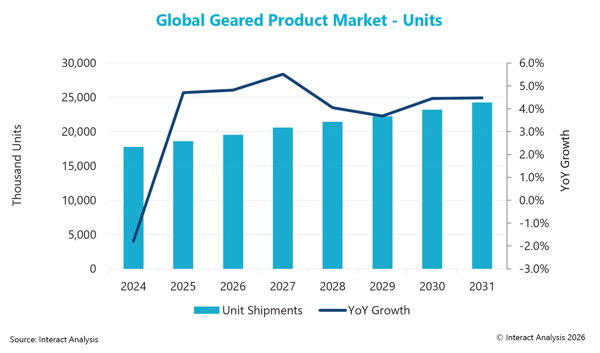
Following a difficult 2024 and 2025, North American construction equipment sales and production growth will be positive in 2026, 2027, and 2028. The surge in data centers is driving much of this; however, the risk of a dramatic slowdown in the near future cannot be ruled out, as an inability of AI companies to drive profitable operations after out-sized IPOs will undoubtedly force them to pull back on capital spending.
Key takeaways
It is imperative for OEMs, and the supply chain, to closely monitor the data center market, particularly investor confidence, which is likely an early warning of a slowdown. For example, an inability on the part of major AI companies to convert subscribers into a positive cash flow, particularly post-IPO, will very likely cause a dip in market confidence and a slowing in data center investment. At the same time, watching for growth opportunities in other construction markets, such as manufacturing or warehousing, is going to allow OEMs to maintain growth in the longer term.